Bridging Engineering Expertise and Software Development Practice
Co-authored with Nina Lu. Originally published on Nina’s site.
The Gap Between Using a Tool and Building It
Quality software can still end up unused unless we close the gap between experts who use it and those who build it. Engineers hold a lot of heuristics and tribal knowledge in their heads, which makes extracting exact requirements challenging.
Users with legitimate grievances come across as frustrated or overly picky. Folks short on time skip release notes or “simple” training and miss key features. Experts with depth in a field can dominate a discussion, discouraging others from speaking and limiting requirements elicitation. Engineers or entire teams may strike out on their own to “build a better solution,” fragmenting the community. As the scope and users of our software grow, one user’s “must have” feature may become another’s pain point.
If we want to deliver a working product with engaged customers, we must craft something they enjoy using and that makes their life easier. Failing that leads to mothballed projects, delays, and missed opportunities.
Turning Engineering Intuition into Requirements
The process begins with eliciting requirements from the customers. What engineers intuitively know needs to be translated into explicit feature descriptions and acceptance criteria. What signals do they look for when examining plots? How do they determine whether a physics simulation produced useful results? What behavior do they expect from a solver as a simulation runs? What data is produced and in which files? What format is the data in? Is there a common naming scheme for files that are always produced by jobs of this type? What criteria determine a successful run? How do they troubleshoot a simulation that failed?
As most software developers don’t come from an engineering background, we need to find ways to extract and understand the knowledge that lives in engineers’ minds, at least enough to see what they’re looking for and build features that meet their needs. Have the business users quantify their intuition. Ask clarifying questions until the request details are clear and explicit, and precisely define the scope of the feature. Ask for sample test cases and run them to see how they behave firsthand. Have the users present a demo. Shadow them for a day or two. Attend their meetings and take their training.
This initial investigative phase sets the foundation for the rest of the development cycle. Gaps in understanding, poor requirements, and ambiguity here will snowball in later phases of the project. We also want users to be excited and on the same page to maintain momentum. Unmotivated users who don’t believe in the project won’t provide the same level of feedback as those who do.
Feedback Loops That Keep Things Moving
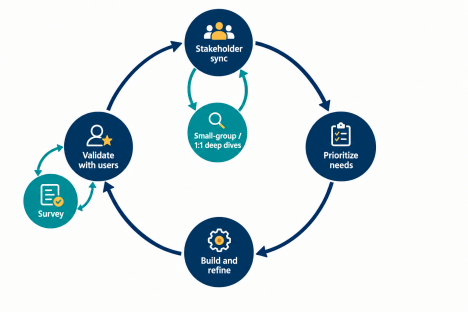
Consistent, recurring feedback loops and follow-up ensure we stay aligned with our customers. Iterate with the users, ask them to validate the delivered features, and collect feedback on what works and what could be improved (e.g., sentiment analysis or empathy interviews). Continuously refine the tool’s available capabilities, but only in lockstep with user needs.
In the initial development cycles, it’s helpful to establish regular sync calls with stakeholders to gather feedback, provide updates on active work, and align on future work. Nothing beats direct interaction with the customer, as it’s easier to discuss and ask questions this way and it helps foster trust in the working relationship.
In between formal sync meetings, keep users in the loop by setting up a dedicated messaging channel for quick updates and questions. Reach out to individuals or subgroups as needed for any deep dive discussions and follow up on threads brought up during a full group meeting. There’s a balance to strike, and over time, you’ll get a feel for when to keep a conversation in a channel and when to break out in a DM.
What Keeps Good Software from High Adoption?
Communication is just one aspect of bridging the gap between the business users and software developers. The overall relationship must be managed effectively or the project runs the risk of losing momentum and failing to achieve its objectives.
Make sure everyone is clearly aligned on the end goal from the start. If the goal is to replace a commercial software product or another existing tool, get a commitment from leadership in writing on an adoption plan with a clear timeline and readiness criteria. The new software doesn’t need to be perfect before beginning the transition; perfection is the enemy of good. Once the software meets the agreed minimum readiness criteria, such as having a working set of high-value features, proceed with adoption without delay. Otherwise we lose sight of the original shared goal and the transition may never occur.
Customer feedback improves the software and should continue alongside, but not block, adoption. Iterate with the customers directly to address their pain points and any gaps in functionality. Tight feedback loops help ensure the software meets the customers’ needs and priorities. But if stakeholders keep moving the initial goalposts and postpone adoption in pursuit of perfection, then adoption may never come at all. Without explicit customer buy-in, further improvements may go unused.
Working with Stakeholders Who Aren’t in Sync
Managing the customer relationship, beyond proactive communication and feedback loops, requires adjusting our approach depending on how the customer interfaces with us. Even if every effort is made to establish open communication, it does not mean customers will be enthusiastic about the partnership or in sync with us. What do we do if a customer is busy and simply does not prioritize testing the feature or working with us to determine further priorities after we deliver on their initial request? What if they don’t respond to messages and are incredibly difficult to reach? What if, during group meetings with engineering partners, one customer has a tendency to interrupt or speak over others, or frequently derails the conversation toward other topics that are only tangentially related at best? What if customers with competing priorities request incompatible features?
There’s no need to idle when potential customers are not responsive to outreach. Follow up a few times, but when one work thread stalls or there’s no traction, move on with discovery and active work with other customers, and circle back when the thread becomes active again. Actively facilitate meetings and ensure everyone is afforded the opportunity to share their ideas; keep the meeting on topic and don’t allow any one person to derail the discussion. It’s your meeting and you’re there for a reason, so know what it is and make the most of the allotted time. Don’t be afraid to politely cut someone off and ask them to get back on topic. Reach out to people individually and follow up if it seems they didn’t get to speak during the meeting with the larger group. Find a way to balance competing interests while serving as many users as possible. For example, if one customer requests detailed reports about simulation progress while another only wants high-level information, you could implement both options and allow users to individually set their preference.
Closing the Awareness Gap
As new features are introduced, new users are onboarded, and current users leave for other departments, training and awareness gaps will emerge. People are busy and might not read through long release notes. Notifications get lost in crowded email inboxes or busy messaging channels. Users may miss new features, leaving advanced functionality unused, which provides no benefit and limits the software’s realized value.
To address this gap, it helps to create reusable learning assets, such as training courses and video walkthroughs, and make them available in a centralized, easily accessible location. Add screenshots or short video clips to text-heavy release notes to make them easier to consume. Share release updates through multiple channels, whether that’s email, in-app notifications, group channel messages, or forum announcements. This expands reach and increases the likelihood of people seeing the update in at least one location.
Reaching Beyond Power Users
How do we make users aware of what help resources are available and where to find them? What should we do when automated outreach channels (e.g., emails or in-channel notifications) are ineffective, especially during release cycles when it would be most helpful to have momentum and user awareness?
It depends on the size of the user base, but manual, individual outreach can be a good avenue to explore. People are more likely to see and respond to an individual direct message with an explicit ask, such as taking a training course or responding to a survey with feedback, than a mass notification. Reach out to their leaders as well and get their support in disseminating information and resources to their teams, using the same approach. Provide a value proposition. If users know their feedback directly contributes to determining work prioritization in the product roadmap, it helps foster engagement and gives them a stake in the development cycle, even if they aren’t typically actively involved. Make sure to close the feedback loop afterward and inform users of the results and any action items that you plan to take - and follow through.
This kind of individual outreach might be tedious and time consuming - and not everyone will respond - but it’s helpful in raising awareness and gathering data about user satisfaction and priorities. It doesn’t help to only ever hear from the same few power users, who likely only make up a fraction of the total customer base. Hearing from the broader user base keeps priorities tied to what most users need, not just what power users ask for. If the user base is too large to reach individually, survey a random sample, stratified across locations and organizations, sized for a 95% confidence level and a 5% margin of error. For a population of 7,000 users, that’s “only” 365 completed responses at 95% confidence, or 608 at 99%.
Where a true random sample isn’t possible, it still pays off to reach as many users as possible, with an emphasis on representative coverage across locations and organizations. This kind of comprehensive outreach doesn’t have to be done very frequently; quarterly or yearly works, depending on the frequency of release cycles and the size of the user base.
Designing for Reuse, Not One-Offs
It’s important to develop reusable patterns and infrastructure, rather than one-off solutions targeting very specific needs. The latter is unsustainable and misses opportunities to expand a feature’s benefit. Instead, focus on patterns that can be extended to multiple use cases, allowing for wider applicability and maximal reuse.
Don’t just stop at fulfilling a singular request as-is; consider how to expand its scope. Aim for designs that give future solvers and use cases a supported way to integrate easily into an existing platform. For example, if multiple different physics solvers generate simulation data of varying formats, and you only get a request to do something for one of them, designing with reuse in mind means we should build an abstraction layer capable of extracting and processing the requested data in a way that’s easy to extend to other solvers. Once the feature is out and other teams see the capability, they may be interested. If we don’t design ourselves into a corner, we can accommodate them faster.
Consider the accessibility of a solution as well. Log files containing useful data for troubleshooting a failed simulation are more helpful when they’re stored in a format that secure AI systems can consume and combine with other context, rather than kept in isolated local storage. Custom, locally hosted scripts are difficult to share with others, but a cloud-enabled platform can expand their reach to the wider organization, allowing other modules and teams to benefit.
Why Authenticity Matters More in the Age of AI
AI can mimic style but mimicry only goes so far; an authentic voice and genuine expertise allow us to push into truly new and valuable territory. Add a personal touch to release notes and other communications; people respond in kind to what they perceive to be genuine.
Human judgment is still required to steer AI and translate customer priorities into useful features, and we remain responsible for everything the AI outputs. We should not outsource our thinking to AI. Agents may be able to generate the code for a feature, but it means little without clear direction and buy-in from customers, nor can AI on its own extract the context it requires. The realm of relationship building, coordination with stakeholders, and strategic thinking plays to human strengths and should be our focus as AI takes over more of the technical tasks.
Conclusion: What Constructing the Bridge Requires
“The hard thing about building software is deciding what one wants to say, not saying it.”
Fred Brooks, No Silver Bullet, 1986
A software project’s success lives and dies with the quality of its requirements. To elicit the right ones, with the right amount of detail, requires a deep understanding of the problem. Achieving that is facilitated in large part by cultivating a true relationship with the customer, one based on trust earned by showing empathy, staying on track, and delivering on our commitments.
Comprehensive surveys of our user population, tight feedback loops, high-quality training, and the difficult decisions needed to honor our goals all help us avoid perpetual betas that never quite bear fruit. But they’re far from the only tools in our arsenal.
The nature of software development work, and our relationship with it, is changing. Yet many things, like our ability to connect at the human level, remain the same. All it takes is a phone call, a hand-crafted message, a warm handshake: anything that signals genuine care for the person on the other end. Software is created to meet a human need. Even if it’s built by and for machines, as in the case of an AI agent writing process control software for manufacturing equipment, if you drill down far enough you’ll find its true purpose is to help people in some way. From the simplest static website to the most complex OS kernel or flight controller, software is crafted to serve people.
And it’s the relationship between these people (our users) and the builders of software that ultimately determines whether what we build will be useful and stand the test of time or join the list of promising solutions that could’ve been so much more.